Astana is a city looking to the future. Fast-paced and dynamic, it has become a symbol of the new Kazakhstan. Yet, the capital also preserves the memory of millennia: the land on which it stands recalls the Botai culture — the era when humans first domesticated horses. It is this contrast — deep antiquity and a modern rhythm — that inspired the creation of CBRB ASTANA. Here, past and present don't simply coexist — they intertwine, creating a space where coffee becomes a bridge between eras.
When the Coffee Boom team created a project in the capital, it was important to reflect its dual nature: respect for history and a drive to move forward. The result is an interior that is simultaneously a museum of ancient traditions and a modern coffee production facility.
Burnt earth
The project's signature color is terracotta. It was chosen for a reason: its name comes from the Italian "terra cotta," meaning "burnt earth." Around nine thousand years ago, humans learned to fire clay in a kiln, marking the first chemical revolution in history. The soft natural material's properties were forever altered by exposure to fire.
At CBRB ASTANA, terracotta pays homage to the pottery of ancient masters. Jebe — a thick-walled clay vessel for fermenting kumiss — was once stored in niches in dwellings next to workshops. Potteries by the rivers stood next to corrals, and horses were the heart of Botai culture and economy. Pottery and horse breeding developed in close connection, complementing each other. The terracotta color pays tribute to this craft and simultaneously evokes the roasted hue of a coffee bean, uniting antiquity and modernity in a single visual code.
Project's signature color
Installations
and art objects
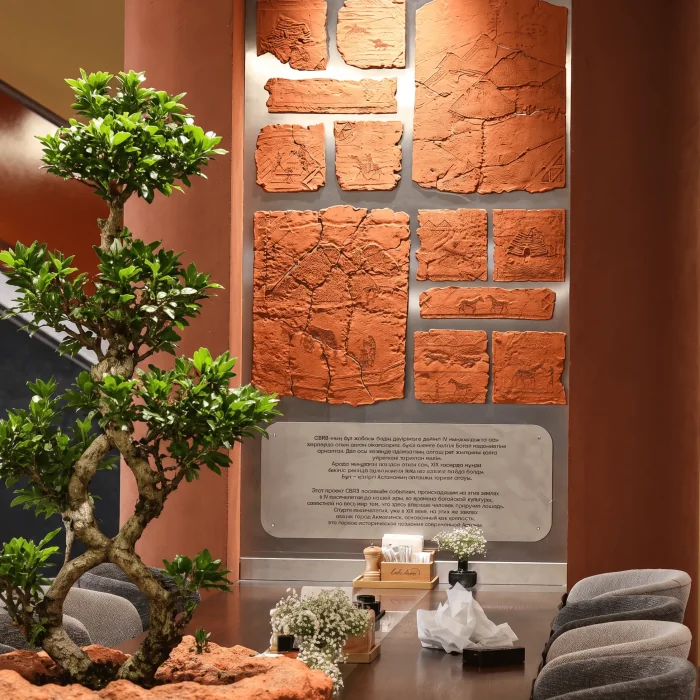
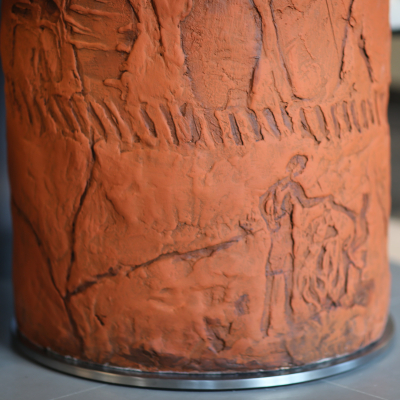
The main installation on the first floor is a vertical panel of fired terracotta-colored clay tablets, imitating cave paintings. It tells the story of the Botai culture: the domestication of horses, and the daily life and dwellings of ancient people. Below, a plaque in Kazakh and Russian explains that the project is dedicated to the 4th millennium BC, when horses were first domesticated here, and to the city of Akmola, founded in the 19th century. All clay elements are handcrafted by artist Asan Boronchinov, each a one-of-a-kind piece. The second part of the installation is a ceramic vessel containing a living tree, whose painting continues the theme of the ancient steppe.
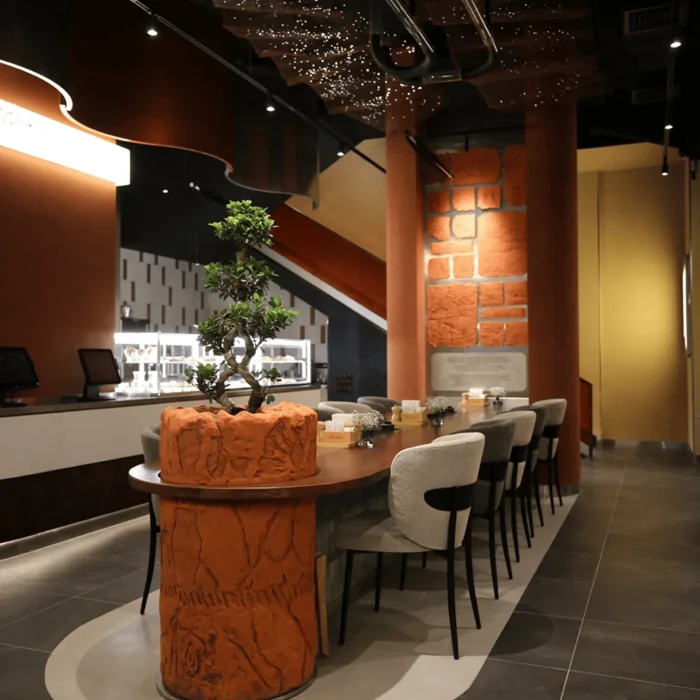
The installation consists of two parts, united by a large table. The second part is a ceramic vessel containing a living tree. The vessel is crafted in the same style, imitating the techniques of ancient masters: its circular painting, like cave paintings, tells the story of the Botai people's lives.
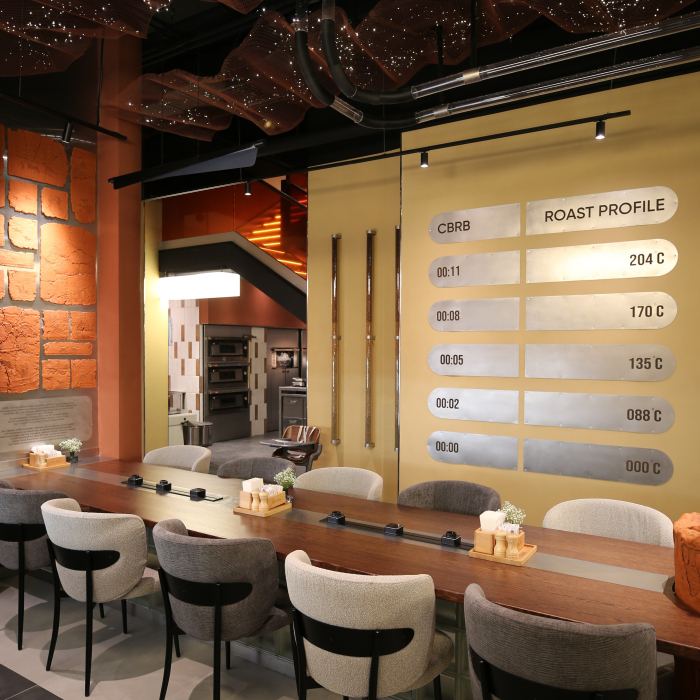
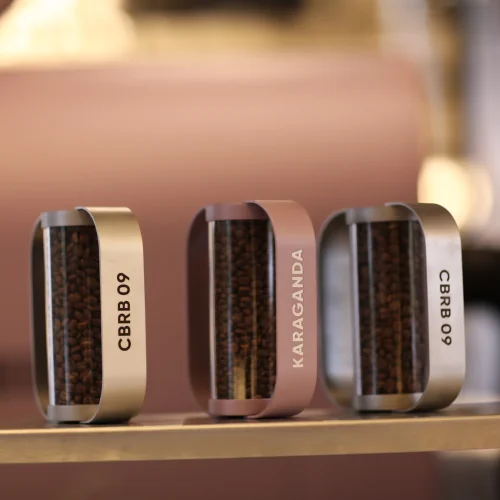
Next to the large table is an installation visualizing the coffee roasting process. Three vertical tubes are filled with beans of varying roast levels, from green to darkest. A roasting profile is attached nearby — a metal plate indicating the temperature for each minute of the process. This is the signature profile used in the project for the permanently.
The second part of the installation features four tubes containing the different varieties of coffee used in the project: Brazilian Cerrado, Ethiopian Sidamo, Tanzanian Rukuma, and Burundi Muyinga. Their transparency allows visitors to see how beans from different selections and varieties visually differ from one another, including color, size, and roast level. This vividly demonstrates the diversity of coffee coming from different plantations, transforming the installation into a living educational resource.
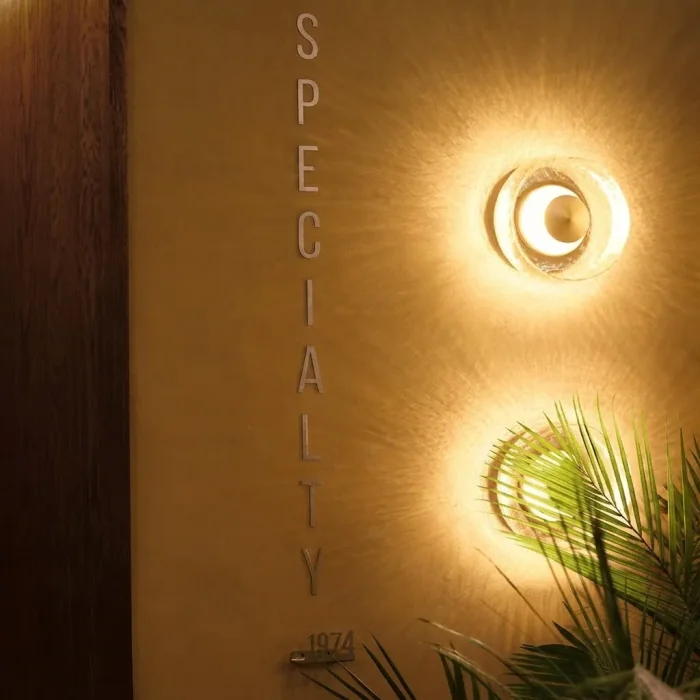
1974 was the year the term "specialty coffee" first appeared in the coffee world. It was coined by Erna Knutsen, owner of the American coffee company Knutsen Coffee. In 1974, she used the word in the Tea & Coffee Trade Journal to describe small, exceptionally high-quality batches of beans with a bright, distinct flavor.
What did she mean? Coffee isn't just a commodity. There are ordinary beans, and then there are special ones — those grown in a good location, carefully harvested and processed, and producing a rich, interesting flavor in the cup. Erna suggested calling such coffee "specialty."
Since then, the essence of the concept hasn't changed. Specialty Coffee is coffee with a history and proven quality. It's not just a high price, but transparency: you know where and how it was grown, who picked it, and why it tastes so good. It's respect for the farmers, the land, and every step of the journey from bean to cup.
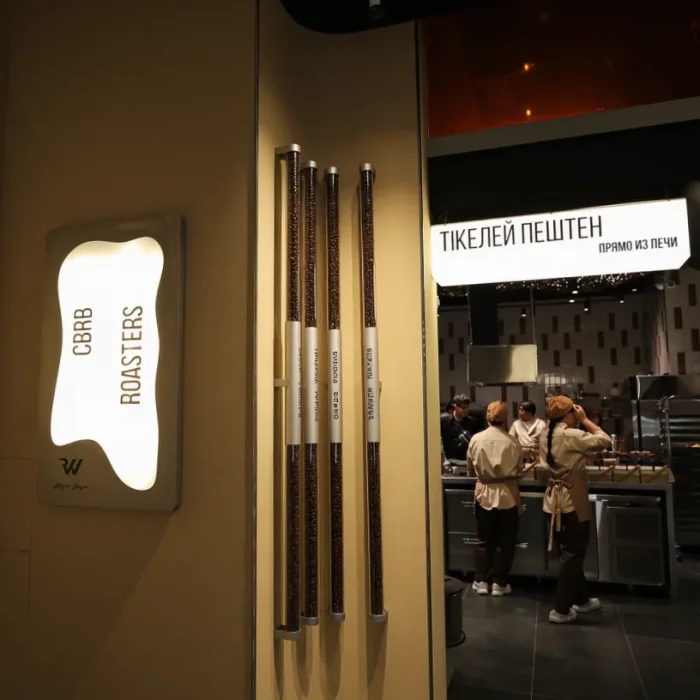
The word "Roasters" is a professional term that has become established in global coffee culture. It signifies that a project doesn't just serve coffee, but roasts it itself. Such projects have a deep understanding of bean roasting, and for them, knowledge of the roasting process is a key value.
The key feature: the roasting machine is installed not in a separate workshop, but directly inside the establishment — on-site. Such projects are rare in the world.
The acronym CBRB stands for Coffee Boom Roasters & Bakery. The "Roasters" part of the name signifies that each CBRB project has its own roasting machine. That's why the sign at the entrance reads "Astana Roasters" — a clear indication that the coffee is roasted on-site.
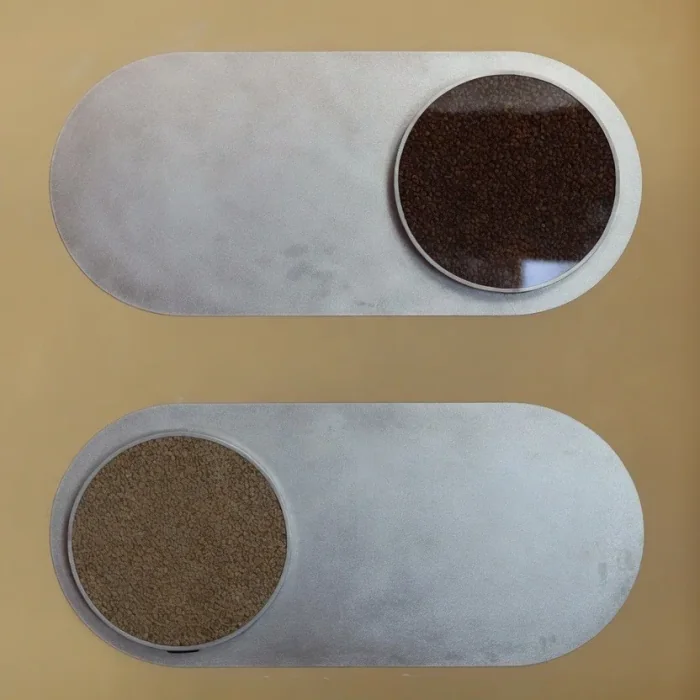
On the ground floor, next to the letters CBRB and the words "Choosing the Best Coffee," three large switches are mounted on the wall — the same kind of on/off switches you'd find on a phone screen. Two of them are filled with roasted coffee and are located at the bottom. The third, on the right, is also completely filled, but with green coffee. It's an art installation that connects coffee with the familiar digital gestures of modern life. We flick these buttons on our devices every day, and here we have the same familiar visual language, but on a larger scale and with real coffee inside.
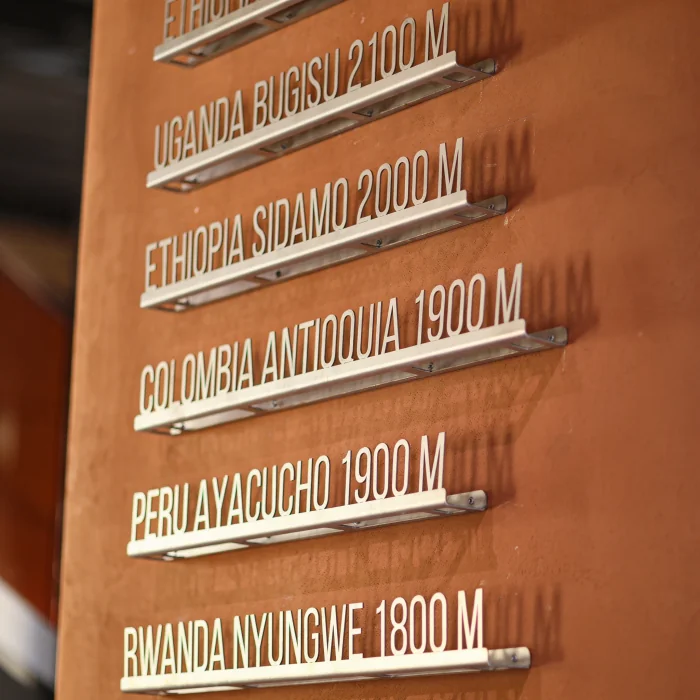
Near the stairs to the second floor, there's an installation about coffee terroirs and growing altitudes. Terroir is a unique microclimate created by nature. It lists not just countries, but specific farms and estates, with elevations listed from low to high. Each is listed with the country and average altitude at which coffee is grown.
The higher the coffee grows, the colder the climate, the greater the difference between day and night temperatures. Because of this, the berries ripen more slowly, become denser, and accumulate more sugars and organic acids. This coffee produces a more complex, vibrant flavor, high acidity, and a distinct aroma. At altitudes above 1,500–2,000 meters, those signature specialty qualities — floral, berry, and fruity notes — often develop. Furthermore, the environment is cleaner at higher altitudes.
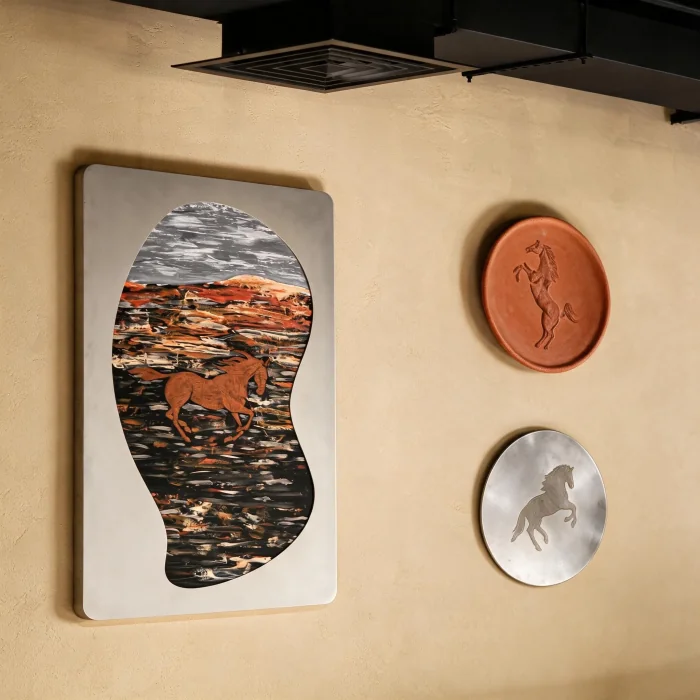
The installation is dedicated to the horse as a symbol of the Botai culture — it was the heart of the ancient settlements' economy, and pottery flourished alongside the corrals. The wall depicts not a herd, but a single image of a single horse in various states: from calm to a galloping pace. It is a metaphor for the journey, freedom, and connection to the past, where the horse "lives out" its life on the walls of the project.
The composition combines two techniques: a ceramic plate, hand-painted like the ancient masters, and a metal circle, laser-engraved, a sign of modernity. Thus, the installation becomes a reflection on the connection between man and nature, on labor and the heritage of the steppe, where every detail reminds us that past and present are parts of a single movement.
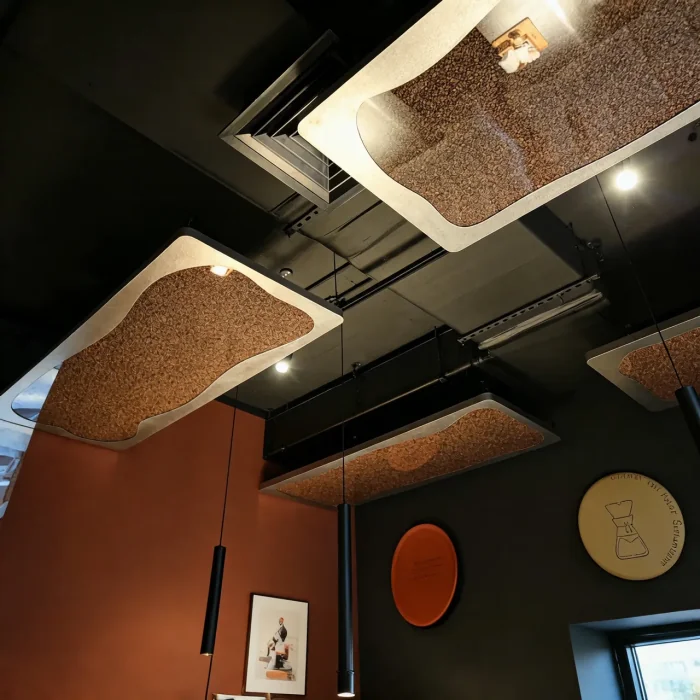
Four floating panels, covered in coffee beans, hover from the ceiling. They create the sensation that the coffee is suspended in midair, right above you — in balance between earth and sky, between the heaviness of the bean and the lightness of flight. This is an installation about gravity, simultaneously obeying and defying it: the bean doesn't fall, it hangs, inviting the visitor to look up and pause for a moment.
This solution is both an art object and an atmospheric detail: lightness, tension, frozen movement.
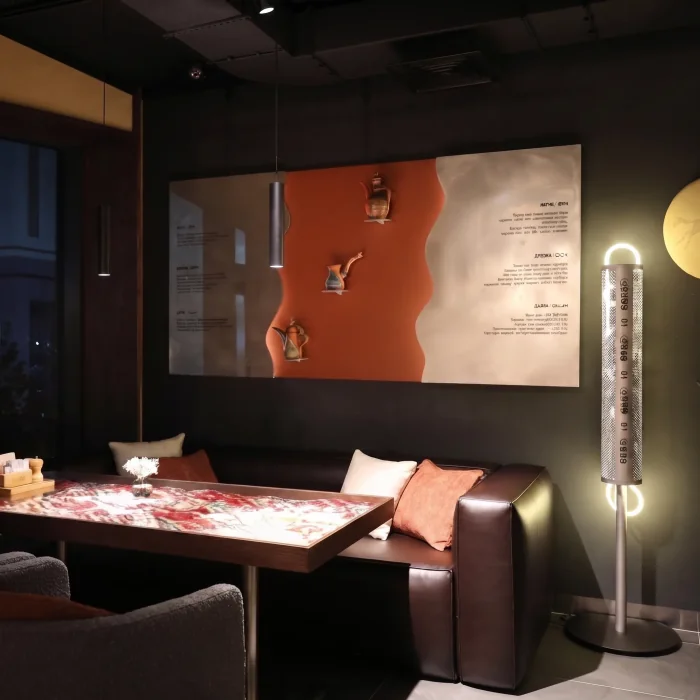
The installation focuses on the most ancient method of coffee preparation z —brewing on sand. It centers on three historical vessels used in coffee culture across different eras and cultures: the ibrik, the cezve, and the dalla. They are placed on separate pedestals, and next to each is an information panel with a bilingual (Russian and Kazakh) description.
The installation consists of two parts. The first is the panel itself, with texts and real vessels on pedestals. The second is an oil painting by artist Asan Serikkazyevich Boronchinov, hanging on the opposite wall. The painting depicts a cezve — the same one on the pedestal, but recreated in painting. Thus, the ancient vessel is reborn — in contemporary art. Together, these two parts form a dialogue in which the real artifact and its artistic representation, history and modernity, craft and painting intertwine.
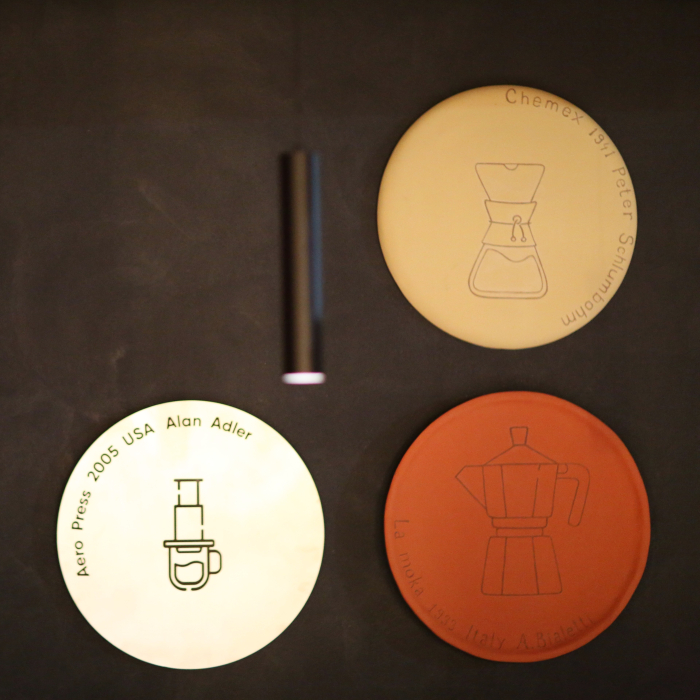
The installation is dedicated to the history of inventions that have changed the way coffee is brewed over the centuries. The composition combines circular panels, clay, metal, and artistic painting — each texture symbolizing a different era. The wall displays images of key devices, from the first hand-held devices to complex mechanisms.
The most iconic inventions, milestones in the evolution of coffee culture, are presented here. Circular panels contain information about the time of creation, origin, and etymology of each element. The installation reminds us that coffee culture was shaped not only by taste, but also by engineering and craftsmanship.
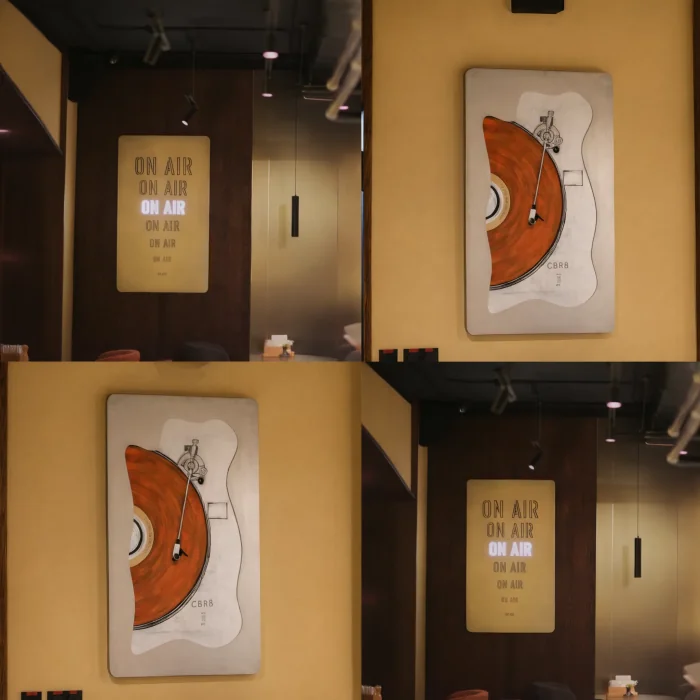
The bar area features two installations that create the atmosphere of the second floor of CBRB ASTANA, where high-quality live music lives.
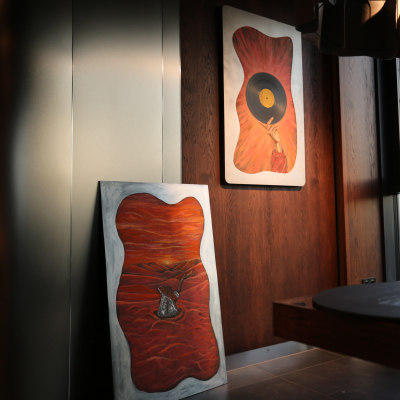
One of them is an "ON AIR" sign, familiar from recording studios. It lights up during recording, symbolizing the pure, studio-quality sound and creative atmosphere. Another is a painting of a vinyl record player, evoking warm, analog sound and immersing guests in a cozy atmosphere. Next to it is a cabinet filled with vinyl records — it not only stores music but also becomes part of the installation, emphasizing the value of live, tangible sound.
Together, these details transform the second floor into a space where coffee culture meets high-quality sound — live, authentic, and free from digital sterility. Here, you can not only drink coffee but also listen to music as it sounds in the world's best studios.
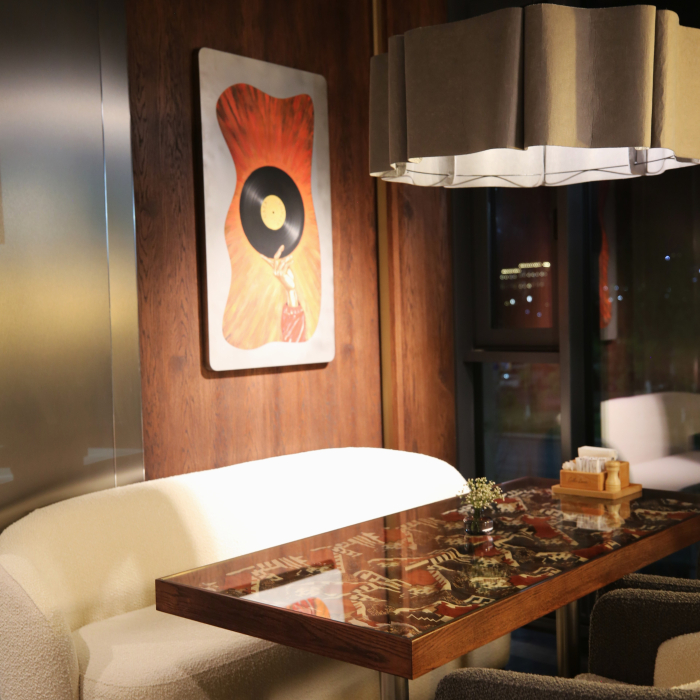
CBRB ASTANA features an installation that combines vinyl and the specialty coffee philosophy of meticulous attention to detail. It consists of three elements. The first is a painting in a metal frame: a hand holds a vinyl record, each groove of which is hand-drawn by the artist with a compass. It's an almost jewel-like work, a symbol of deep concentration.
The second is a carpet under glass, referencing textile traditions and adding warmth to the composition. The third is a painting with an ornament by the artist Asan, which echoes the carpet's patterns and completes the semantic triangle.
Together, these three elements speak to one thing: the level of quality inherent in coffee extends to art. Every line, knot, and brushstroke requires time and love. This is specialty in the broadest sense — not just the evaluation of the bean, but the careful attention to every form, sound, and detail.
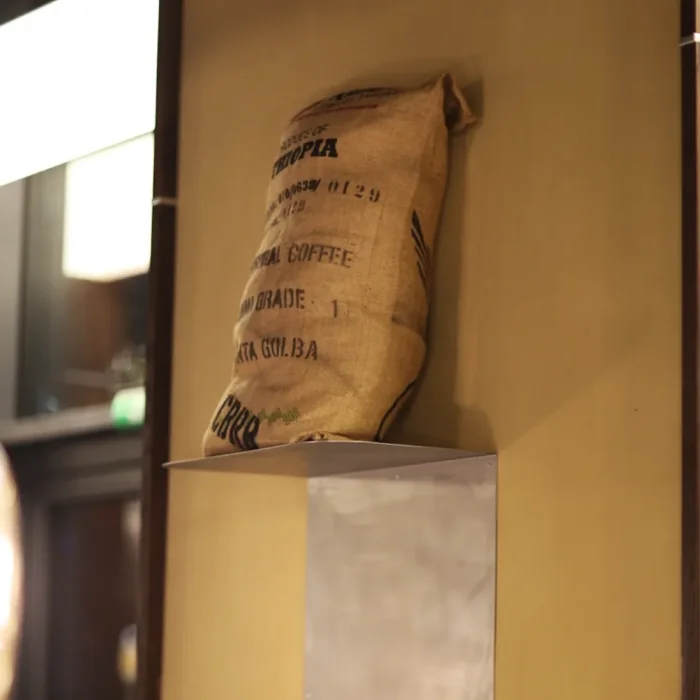
Every CBRB project features a jute bag. This isn't a prop, but a real bag, the one the coffee actually came in from the plantation. In this case, it's a 30-kilogram bag (typical for Specialty lots) from Ethiopia. It's embossed and painted with the Weroast and CBRB logos.
Unlike the storage area, where the green beans are vacuum-sealed, this bag stands on a pedestal "live" — just as they are unloaded from shipping containers. It serves to enhance the immersive experience for guests, allowing them to see and touch the packaging in which the coffee crosses the ocean, arriving from its growing countries and specific plantations. The specialty lot used in the project to prepare filter coffee was actually purchased and delivered to CBRB in this very bag.
Thus, the installation becomes a bridge between the geography of coffee and your cup.
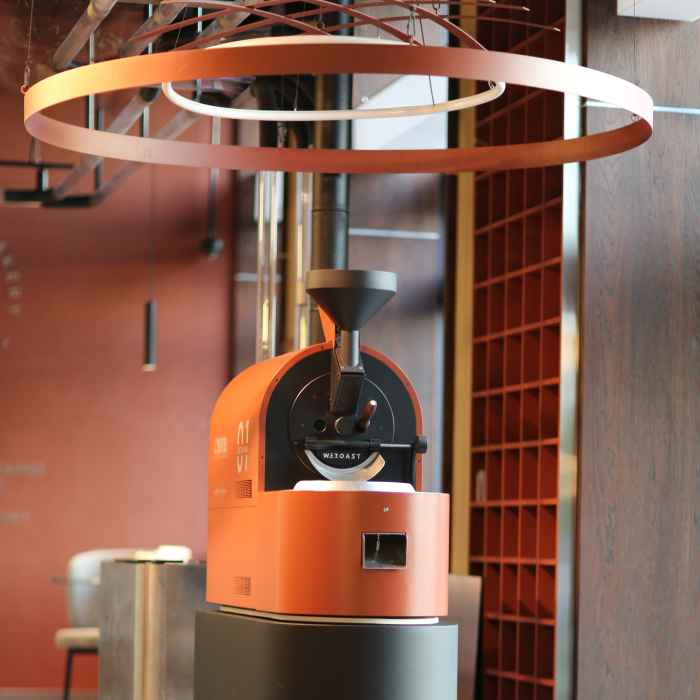
A structure floating above the roasting room alludes to the shanyrak — the dome of a traditional Kazakh home, the yurt. In Kazakh culture, the shanyrak has been a symbol of home, family unity, and clan for centuries — the thing that keeps a roof over one's head, both literally and figuratively.
In CBRB's interior, this form is combined with hanging ethnic metal ornaments and placed above the heart of the establishment — the coffee roasting area. The message is simple and unpretentious: at CBRB, guests are the most respected guests in the house, and the roasting room beneath the shanyrak represents the warmth and care the team pours into every cup.
Openness without borders
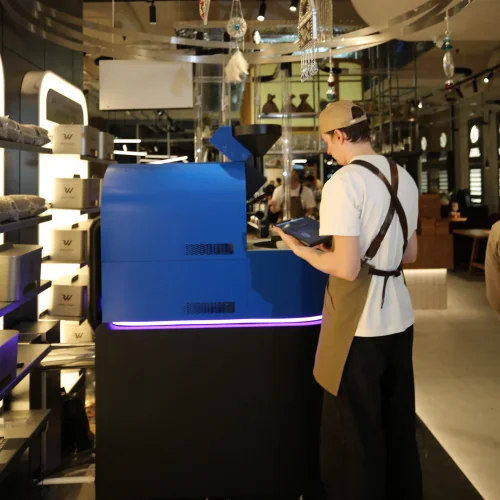
The core concept of CBRB ASTANA is eclecticism, a blend of tradition and history with modern technology. Astana is a capital, a flagship city, looking to the future while preserving the memory of millennia: here, on this land, in the 4th millennium BC, the Botai culture arose, where humans first domesticated horses. The coffee shop is conceived as a coffee factory, but with one key feature: there are no walls between the guest and the process. The "no boards" concept means complete openness: the roasting area, the degassing workshop, the bean transportation — all of this takes place right before the eyes of the guest.
There are very few projects in the world where you can see coffee roasting in the open. Even in large cities, these areas are often separated by glass. CBRB ASTANA has become one of these unique spaces — right in the heart of the capital. Guests can approach the roasters, watch the roasters at work, and ask questions —this creates a true connection with the product, while the ancient history of the steppe comes alive in the interior, reminding us of the deep roots of this place.
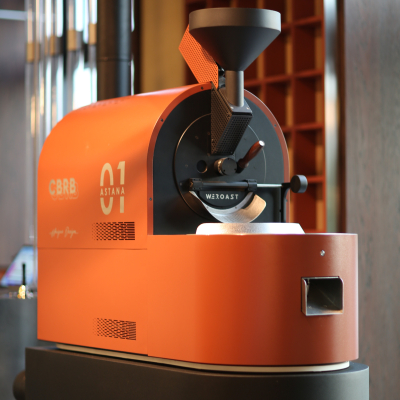
WEROAST ROASTER
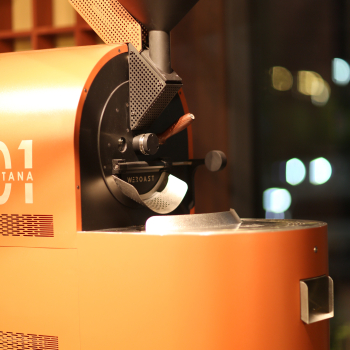
The roasting machine is the central element of the CBRB ASTANA roasting area, crafted in the signature terracotta color that has become the project's signature color. The project's logo, CBRB, is engraved on one side, along with the Astana region code.
The design of this Weroast Model R 4.2 roaster was specially developed by Weroast Unique Design team for this project. The color palette, engraving placement, application technique, and even the shades are unique to CBRB's projects. The machine not only serves its functional purpose but also serves as the main art piece in the roasting area, attracting guests' attention and emphasizing the uniqueness of this space. Its color and engraving make it a focal point and a symbol of CBRB ASTANA's exclusivity.
WEROAST FLOW
WEROAST FLOW is a pneumatic system styled as an industrial equipment. Four transport lines, three of which lead to the bar and the fourth returns the beans, stretch across the entire first floor, turning coffee service into a true perfomance. Designed by Weroast Unique Design team, it serves two purposes: as a functional system for delivering beans from the roasting area and as an art object that captivates guests.
The receiving silos at the bar are an extension of FLOW. Styled like industrial bins, they receive the beans from pipes and transfer them to the barista. Like the entire system, the silos combine function and aesthetics, keeping the process open to everyone who enters the CBRB space.
WEROAST FROZ
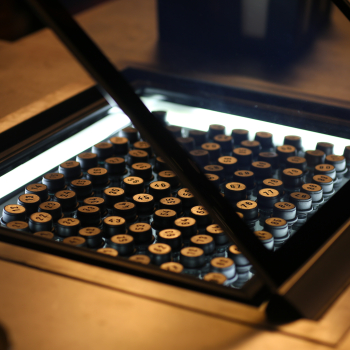
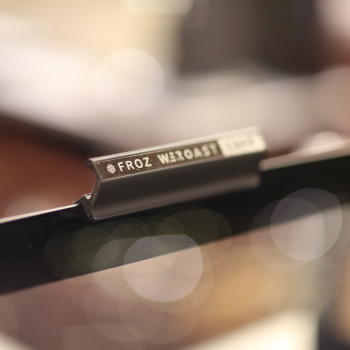
CBRB ASTANA uses frozen coffee for its V60. Weroast Unique Design team developed specialized WEROAST FROZ chambers with a unique appearance specifically for the CBRB chain. The system integrates a chamber, lot identification cards, engravings, and is used for customized roasting profiles. Terracotta-colored plates with color coding are created for each lot: white and gray for espresso, terracotta for frozen V60 lots. After degassing, the coffee is packaged in glass tubes with check valves and placed in a freezer at -20°C, where the rate of bean aging is slowed by 16 times.
Coffee bean degassing zone
The degassing zone at CBRB ASTANA is a crucial stage in the coffee processing process after roasting, where the beans stabilize, releasing their flavor and aroma before packaging. The central element is an electronic counter displaying the total volume of roasted coffee since the project's launch. It charts the space's evolution since its opening.
After roasting, the coffee is placed in signature stainless steel containers, each individually numbered. The accounting system tracks which lot is stored inside and how long it takes to degas — from a few hours to a day, depending on the variety and profile. Once the process is complete, the beans are sent for packaging or to the barista.
Grain storage area
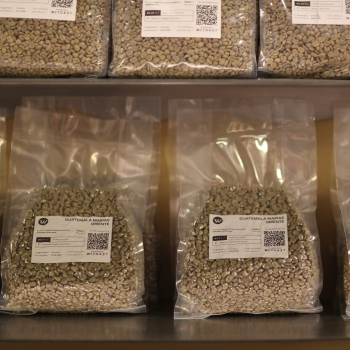
This is the green coffee bean vacuum storage area. Vacuum packaging preserves all the flavor and aroma properties of green coffee, prevents oxidation and environmental exposure, and extends shelf life without losing quality. Unique labels describing the green coffee (varieties, origin, and characteristics) were created here for the CBRB ASTANA project. The labels are available in two languages — Kazakh and Russian.
A storage area for roasted beans is located nearby. They are also packaged in special bags with degassing valves, allowing the coffee to "breathe" and maintain freshness. The space is designed so guests can see the entire journey of the beans — from green to ready-to-drink.
The past and the present come together in one cup
CBRB ASTANA is a space where millennia of history come alive in the interior details, and modern technology makes the journey of the coffee bean accessible to everyone. Here, Botai culture meets specialty coffee innovation, and ancient pottery meets pneumatic bean transport systems. Every installation, every color, every vessel, and every plaque tells a story, inviting guests to become not just an observer but a participant in the process.